
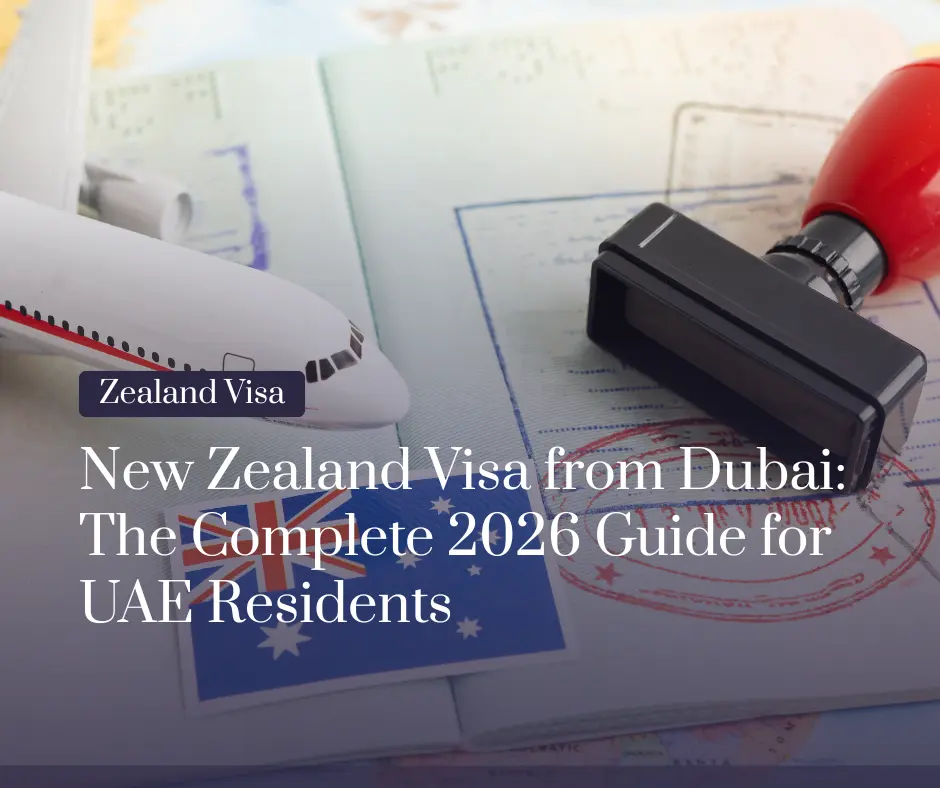
New Zealand Visa from Dubai: The Complete 2026 Guide for UAE Residents
Ask anyone who’s been to New Zealand and they’ll tell you the same thing: it’s worth it. Every bit of the trip, the flight, the jet lag, the planning, worth it.
The visa part, though. That’s where people get stuck.
Not because it’s impossible. It isn’t. But the process looks completely different depending on your passport, and a lot of expats in Dubai don’t figure that out until they’ve already started filling in the wrong forms. So before anything else, before you book flights or browse Airbnbs in Queenstown, let’s sort out which category you’re actually in.
Do You Need a Visa, or Just an NZeTA?
Your Dubai residency doesn’t factor into this at all. New Zealand decides what you need based on your passport nationality. Full stop.
There are two routes:
Route 1, NZeTA. If your passport is from a visa-waiver country (the US, UK, most of the EU, and several others, UAE nationals are in this group too), you don’t apply for a visa in the traditional sense. You apply for a New Zealand Electronic Travel Authority, or NZeTA. It’s online, it takes about ten minutes to fill in, it’s valid for two years, and most people get approved within 72 hours. Genuinely easy.
Route 2, Visitor Visa. If your passport isn’t on the waiver list, and for most South Asian expats in Dubai, Indian, Pakistani, Bangladeshi, Filipino, it won’t be, you need a proper Visitor Visa before you travel. This means documents, possibly a biometric appointment, and a wait of several weeks for a decision.
Most of the expat population in Dubai is in Route 2. If that’s you, keep reading. If you’re in Route 1, the NZeTA website will have you sorted in an afternoon.
What the New Zealand Visitor Visa Actually Covers
It’s issued by Immigration New Zealand (INZ) and lets you enter for tourism, to visit family, or for short business trips. You cannot work on it. That’s a hard line, not a grey area.
Standard approval is for up to three months. Some people get longer depending on their situation, but three months is the baseline to plan around.
One thing that surprises people: there’s no embassy to visit, no paper form, no queue. The whole application goes through INZ’s online portal. You upload everything, pay by card, and submit. The only time you might need to physically go somewhere is if your nationality requires a biometric appointment at a VFS Global centre in Dubai, fingerprints and a photograph. But that comes after you submit, not before.
The Documents: What INZ Actually Wants to See
This is where most applications succeed or fail. INZ isn’t just looking at whether you have a passport, they’re building a picture of who you are, why you want to go, and whether you’ll come back. Every document is a piece of that picture.
Here’s what you’ll typically need to put together:
1.The basics, identity and residency:
- Passport with at least six months validity beyond your travel dates. Not six months from today, six months beyond when you plan to leave New Zealand.
- UAE residence visa copy
- Emirates ID
- Return flight bookings or a clear itinerary
- Accommodation bookings in New Zealand
- A travel plan, where you’re going, roughly when
- Bank statements for the last three to six months. Not just a balance, INZ wants to see consistent activity. A statement that shows one big deposit followed by nothing looks suspicious.
- Employment letter from your company. It needs to state your position, your salary, your approved leave dates, and that your job will be there when you return. A generic HR letter won’t do it.
2.Proof you’re actually going:
3.Proof you can support yourself:
4.Proof you’ll come back:
This is the one people underestimate most. INZ calls it “ties to your country of residence.” What it means in practice is: why would you leave New Zealand? If your application doesn’t clearly answer that, through a job, a family, a lease, property, the officer reviewing it has no reason to believe you’re planning to return. A solid employment letter already covers a lot of this, but the more you can show, the better.
For some nationalities, additional medical or character documents:
Indian, Pakistani, Bangladeshi, and Filipino applicants are frequently asked for a chest X-ray from an INZ-approved panel physician, particularly for stays of six months or longer. The key word is approved. A chest X-ray from your regular clinic will not be accepted. INZ publishes a list of approved panel physicians; check it before you book anything. A police clearance certificate may also be required depending on your circumstances. INZ will tell you if they need it after you submit.
How the Application Actually Works, Step by Step
Step 1: Confirm Which Visa You Need
Go to the Immigration New Zealand website and use their visa finder. Put in your passport nationality and your reason for travel. It tells you exactly what you need to apply for. Don’t skip this, assuming you know the answer has tripped up a lot of people.Step 2: Get Your Documents Ready Before You Start the Form
The online application will ask you to upload documents as you go. If you start the form and then realise you’re missing your employment letter or your bank statements aren’t ready, you either have to save and come back or rush documents together. Neither is ideal. Get everything prepared first, in the right format, before you open the portal. Every document needs to be clear and legible. If anything is in a language other than English, attach a certified translation, not a typed version, a certified one.Step 3: Fill In the Form and Submit
Create an account on the INZ portal. The form asks for personal details, travel history, employment, and the purpose of your visit. Answer everything accurately. INZ checks applications carefully, and a mismatch between what you write and what your documents show is a problem. Don’t embellish, don’t guess, just be precise.Step 4: Wait to Hear About Biometrics
After you submit, INZ may instruct you to attend a VFS Global centre in Dubai for biometrics. This is fingerprints and a photo. Do not pre-book a VFS appointment before you receive this instruction, wait for the notification, then follow the steps they give you.Step 5: Track and Wait
You can check your application status through your INZ account using your reference number. For most standard visitor visa applications from Dubai, the realistic wait is 20 to 30 working days, that’s four to six weeks. Busier periods can push it longer. Do not apply four weeks before your flight. Just don’t.Step 6: Download and Print Your Approval
Your visa is electronic. There’s no physical stamp, no sticker in your passport. INZ links it digitally to your passport number and airlines can see it when they check you in. That said, print a copy of your approval letter. Hotels ask for it, immigration officers at Auckland or Christchurch may want to see it, and having it in your bag costs nothing.
When Should You Apply?
Six to eight weeks before travel is the minimum. If your application might need a health exam or police certificate, add another two to three weeks on top of that.
A family trip, or a first-time application, or any situation that’s slightly complex? Apply three months out. There is no downside to applying early. There are significant downsides to cutting it close.
Why Applications Get Refused, and How to Avoid It
No clear reason to return to Dubai.
This is the number one reason visitor visa applications fail. If your employment letter is vague, your bank statements are thin, and you haven’t shown anything that ties you to Dubai, a job, a family, a home, INZ has no evidence that the trip is just a holiday. Build a strong ties-to-Dubai story through your documents.
Bank statements that raise questions.
A large deposit appearing just before the application looks like it was put there for the application. Very low or dormant accounts suggest you can’t fund the trip. INZ wants to see that your financial life is real and ongoing.Documents that are illegible, incomplete, or poorly translated.
A scan where the passport number is blurry. A bank statement missing the last page. A document in Urdu or Malayalam without a certified English translation. Any of these can result in a rejection or a request for resubmission, both of which cost time.Using a non-approved physician for the health exam.
If INZ asks for a chest X-ray and you get it done anywhere that’s not on their approved panel list, it won’t count. Full stop.
Leaving it too late.
If your travel date arrives before your visa is approved, you can’t travel. No exceptions.
Should You Use a Visa Agency?
The INZ portal works. You can apply independently. But a rejected application isn’t just an inconvenience, it’s a lost application, a record that INZ can see on future applications, and weeks of delay at minimum.
Most rejections happen because of document issues. The wrong format, a missing page, a statement that raises a question nobody thought to answer. A visa specialist who handles INZ applications regularly knows what to look for before it becomes a problem.
RAG Visa helps UAE and Qatar residents through the New Zealand visa process, from checking your documents before submission to following up on application status. If you want to know what your specific application needs before you start, get in touch.

Best and Affordable Austria Schengen Visit Visa Services Qatar in 2026
Switzerland Visa from Qatar: Step-by-Step Guide

Netherlands Visit Visa from Qatar: Requirements, Process and What Causes Rejections

How Much Bank Balance Is Required for a Cyprus Visa?
Vietnam Visa for Qataris 2026: e-Visa, Fees and How to Apply
How to Get a Russian Visa from Dubai in 2026: Complete Guide for UAE Residents

Schengen Visa Rejection Reasons: Top Mistakes and How to Avoid Them
A Complete Guide to Securing Your US Visa Appointment from Dubai
Qatar to Malta Visa Requirements 2026
How to Apply for a Japan Visa from Dubai Without Rejection
Azerbaijan Visa Guide for Qatar Residents: E-Visa and Easy Application Process
Saudi Arabia Visa From Dubai: Complete Guide for UAE Residents in 2026
How to Get an Indian Visa from Qatar in 2026
Singapore 90 Day Visa from Dubai: What It Covers, and How to Apply

What Nobody Tells You Before Hiring a Visa Agency in Qatar
New Zealand Visa from Dubai: The Complete 2026 Guide for UAE Residents
How to Apply for a Schengen Visa from Qatar (2026): What You Actually Need to Know

Rejected for a US Visa in Dubai? Here’s How to Avoid It Next Time 25/11/2025

How to Get a Visa for Canada from Dubai: Everything You Should Know 18/11/2025
